

Art Faculty Featured in BRAHM Exhibition’s Field Studies
Four faculty members from the Department of Art are among the artists featured in Field Studies: Ways of Knowing Place in Southern Appalachia at the Blowing Rock Art & History Museum (BRAHM).
The exhibition, co-curated by Jennie Carlisle, Curator and Director of the Smith Gallery at Appalachian State University and Ian Gabriel Wilson-Rhodes, BRAHM’s Curator of Exhibitions & Collections, features works by Andrew Bailey Arend, Mark Nystrom, Jody Servon and Joshua White.
Field Studies brings together contemporary artists whose work grows out of sustained attention to the landscapes, materials, histories and lived environments of Southern Appalachia. Working across film, sound, photography, textiles, ceramics, sculpture and installation, the artists draw on modes of field study and observation associated with the natural sciences, historical records and archives. In doing so, they respond to the region's long history of documenting its distinctive biodiversity and culture, while asking what it means to draw from and represent this landscape today.
Though diverse in media and method, the artists share a sense of being of this land and intimate with it. Rather than the grand views and distant perspectives often associated with landscape as a genre, they move toward close looking, deep listening and direct tactile engagement with the details that make up an environment.
Taking an ecological approach, the artists emphasize human entanglement with nature, treating the materials at the heart of their work not only as subjects to be represented but as active participants that shape the work itself. In this framing, art-making becomes one way of knowing a place, a process built on observation, familiarity, repetition and care.

Arend’s wood carving Greenbrier Vine began with a pine tree felled at his home. Arend hand-carved a plant native to the Appalachian landscape, enlarging greenbrier from a tangled, often-overlooked vine into a sculpture more than twenty feet long.

As Jody Servon passed by trees which had been sawed away to clear storm debris, she bent down and kissed their cut surfaces in a motherly gesture of acknowledgement and healing. Afterwards, she photographed the cut to record the tree's unique life story and its suffering.
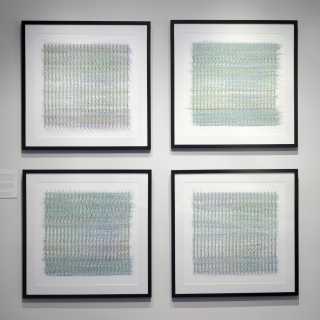
In Mark Nystrom’s series, he visualizes an entire year of hourly wind conditions at locations featured in the exhibition. Individually, each drawing tells the story of the unique wind conditions in 2025 for the place the drawing represents. Collectively, the drawings offer a composite view of the Southern Appalachian region spanning over the year.
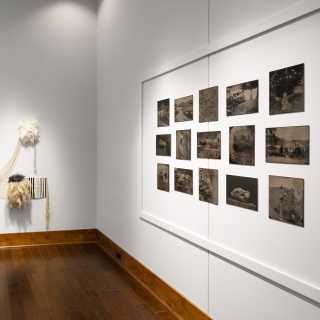
For the past seven years, Joshua White has spent time with families living and working on small-scale farms in western Watauga County. The resulting series, Breaking Ground, documents people, fields, tools, structures, animals, and the rhythms of labor that shape life close to the land.
Field Studies remains on view through January 9, 2027 at the Blowing Rock Art & History Museum. More information is available at BlowingRockMuseum.org.

